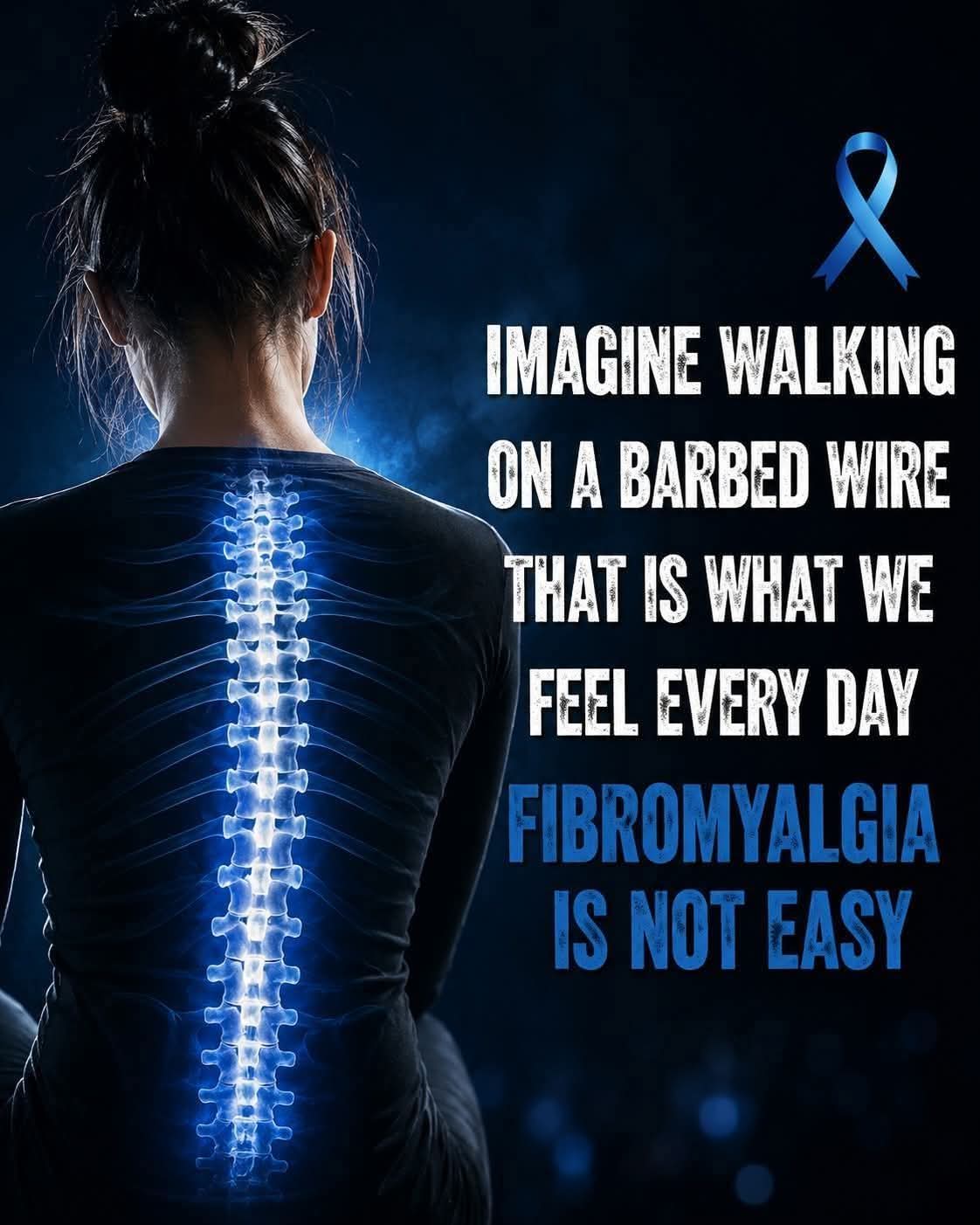
IMAGINE WALKING ON A BORBED WIRE THAT IS WHAT WE FEEL EVERY DAY FIBROMYALGIA IS NOT EASY
You can’t see fibromyalgia – it’s difficult to understand

Esma, 48 years old
“There are two sides to me because of this illness: I seem jolly and happy despite the pain when I’m with other people, but I’m totally worn out afterwards.”
It took a long time until I got a diagnosis for the symptoms I’d been having for decades: fibromyalgia, which literally means “fiber muscle pain.” You experience inexplicable pain, you get exhausted much more quickly than other people, and you’re sensitive to touch and sleep badly.
I have had repeated attacks of stabbing pain in both legs, my arms and my chest since childhood. And nobody could explain where it was coming from.
Along with the pain, I suddenly had no more strength in my muscles and would fall over if my legs hurt. Or I would drop things if the pain shot into my arms. I even lost consciousness a few times and injured myself falling, once quite seriously on my knee.
These pain attacks always come in waves. There are phases where my symptoms are only very weak, and then other phases with extreme pain attacks. You can’t predict how the pain will develop, it’s totally random.
My doctor recommended inpatient treatment at a clinic that was specialized in fibromyalgia. They gave me very detailed information about the disease. That was important and really helped me.
On the one hand it was frustrating to learn that I would always have the pain and that the key thing is to learn how to cope with it. On the other, it was a relief to hear that it isn’t a life-threatening disease, even though the pain is so extreme. I was able to take stock of it better and found solace in the fact that I would live just as long as other people.
What really helped me at the time was going to a ‘cold room’. It’s astonishing, but it really worked. And regular, moderate exercise was a real game changer. That really helped me both physically and mentally. I was given steroid injections to help with the pain, too, but that’s no longer recommended these days.
I only really started doing sports seriously later on at a rehabilitation clinic for my asthma. It was good for my asthma and the fibromyalgia. I wasn’t really confident enough before that because I didn’t want to make the pain worse, was often tired, and couldn’t muster up the energy.
But I got really good support at the rehabilitation clinic, and was told to just move about and not think about it, despite the pain. I had to start from scratch because I hadn’t properly done sports for a long time. At first I just did gymnastics and light fitness exercises once a week, nothing too strenuous
I later started going Nordic walking, and at some stage I was even doing that three times a week. I was also going to training twice a week at a sports club and went swimming at least once a week.
The group training motivated me. I wouldn’t have been disciplined enough on my own. It’s just nicer to be out with other people.
Over the years, some stressful events made the pain worse. For instance, my mother’s death – she died at a young age. And a depression that I had ten years ago.
The pain really flared up again at the time, even though I had been doing relatively well in the years before. I was given antidepressants for the depression, and that helped me mentally. But unfortunately the medication didn’t relieve the fibromyalgia pains.
The pain was also a strain on my relationships with my children and other people. I wasn’t just in pain, I was also very tired and aggressive, also towards my children, who didn’t understand. I feel very sorry about that now.
And it was just as difficult for them to understand that I couldn’t cope so well with physical closeness. I couldn’t stand having someone lean on me. And I couldn’t carry them or carry heavy things for them, either. Otherwise, my shoulder and neck started hurting right away.
We tried to explain as much as possible to my children. For instance, we all went to see my doctor together as a family so that they could ask any questions they had. But even with all the explanations, they still didn’t really get it, they were probably just too young.
The difficult thing is that you can’t see anything. I looked agile and healthy, but was actually stressed out and aggressive.
Our friends and lots of adults understood it even less than the family. They couldn’t comprehend that I get tired quickly even if I haven’t exerted myself and look fit enough. The tricky thing with fibromyalgia is that it is a little “fuzzy”, it comes in many forms and is difficult to pin down.
And I also tried not to show it. I want to enjoy time with my friends and at work and not just think about the pain. That’s why when I’m with other people, I’m still jolly and happy despite the pain. But I’m totally worn out when I get home afterwards. There really are two sides to me because of the illness.
The support groups have really helped me. Talking to like-minded people is especially helpful. We do lots of things together, support each other, and don’t have to explain everything in detail to one another. You’re not alone with it all.
I used to be a member of the Rheumatism Association (Rheumaliga), now I’m in the Fibromyalgia Association, which is a little more specialized. I’ve given info brochures to lots of friends and colleagues. Unfortunately, they never read them. And none of them have taken me up on my offer of coming along to a group meeting. Nobody wanted to really delve into the disease.
One thing I’ve noticed: Those of us who are affected sometimes even forget that the others are ill and have the same problems. You get annoyed if they call something off at short notice.
And it’s sometimes tedious and hard work to listen to other people’s stories: “Where exactly you have this or that type of pain” – it’s annoying and exhausting.
Just like the perfectionism that lots of people have. You want to do everything right, but you can’t focus, you’re irritable, and become too much for yourself and others to cope with. Then I sometimes understand how people close to me must feel when I expect them to be patient.
Going into early retirement ten years ago was a huge relief for me. I’m a social education worker and worked with children who skipped school.
The working conditions were very stressful, even for healthy coworkers. But the whole school system really finished me off. I can no longer imagine going to work. I simply wouldn’t be able to handle it, even though I can now cope better with my illness.
It’s important not to overstretch yourself, including with sports, even if it’s good for you and enjoyable. When I used to train on my own I was focused on my performance and was determined to keep on improving. But I often overdid it and ended up in even more pain. Training in a group is safer and more relaxed, it’s about getting exercise and not about reaching goals.
Another thing that I do to feel better is to take a break and go on vacation by myself. The benefit is that I can just decide for myself what I want to do. I don’t have to adapt and agree with everyone else, which means I’m not stressed out and can decide what I need from day to day.
But when I’m on my own, I am at the mercy of my own willpower. If the fatigue sets in, I don’t manage to overcome it. That’s the advantage of rehabilitation programs. You are part of a fixed daily routine and you have the community. That’s why regularly taking part in rehabilitation programs helps me. It gets you out of the everyday and the usual routines and you get lots of motivation.
I’ve learned to cope better with my fibromyalgia over the years. At some stage, everything just clicked into place. I don’t think about my symptoms so much anymore. I can’t change anything anyway, so I just accept life with the symptoms as if they were a companion.
My tip would be to focus on the fact that it’s not life-threatening. That made a big difference to me. Before that, I was scared that there was something serious going on every time I had a pain attack.
It’s just as important to not pay too much attention to what your own body is telling you. And not to talk about it too much, either. You always have these different thoughts in your mind, like “Am I being too sensitive? Should I be a bit tougher and stronger?” and “Am I talking about it too much? Am I getting on everyone else’s nerves? Am I getting on my own nerves?”
It sounds strange but I would recommend not paying too much attention to your own thoughts and find something to distract you instead. That’s maybe the most important but at the same time most difficult piece of advice.