
6 ways to manage your fibromyalgia
NIH-supported experts explain how you can help relieve symptoms

If you’re living with fibromyalgia, it’s important to make time for self-care. It’s a chronic (long-lasting) condition that causes muscle pain and tenderness all over the body. This can make it hard to move, relax, or sleep, and it can cause mood and memory problems, too. NIH MedlinePlus Magazine asked two top fibromyalgia experts (and NIH grantees!) for tips on how to support your physical and mental well-being.
1. Exercise regularly
It may hurt to move at first, but research shows that gradually increasing exercise can reduce pain. Start with gentle movements such as tai chi or yoga, said Leslie Crofford, M.D., Division Director for Rheumatology and Immunology at Vanderbilt University Medical Center. Low-impact aerobic activities such as swimming, walking, and biking are great options, too.
Communication between the brain and body is altered in fibromyalgia. But regular exercise helps the brain become more accustomed to your body’s movements, Dr. Crofford explained. A physical therapist or exercise physiologist (a professional who creates fitness programs) can provide you with more personalized exercise plans.
2. Reduce stress
Stress can make fibromyalgia worse, so it’s important to spot stress triggers in your life. Cognitive behavioral therapy (CBT) can teach you ways to cope with emotional stress and depression. CBT can also teach you how to avoid negative self-talk, organize tasks so they are less tiring, and cope with pain flare-ups.
You may not be able to do all the things you once did or to do them in the same way, but pacing yourself can help you try to conserve your energy each day. Relaxation techniques such as guided visualizations and breathing exercises can also help. Doing too much can make your symptoms worse, so be kind to yourself!
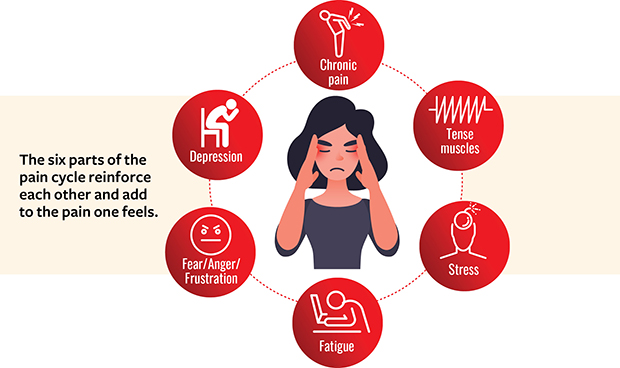
3. Get enough sleep
In fibromyalgia, fatigue can affect pain, which can worsen fatigue… and the cycle continues. That’s because the same neurotransmitters (which carry messages between the brain and the rest of the body) that control pain also control sleep, mood, and memory, said Daniel Clauw, M.D., Director of the Chronic Pain and Fatigue Research Center at the University of Michigan. This makes getting enough sleep essential.
Try following good sleep habits: Go to bed and wake at the same time each day, reduce daytime napping, and try to only use your bed for sleep.
4. Incorporate complementary health approaches
In addition to CBT, tai chi, and yoga, vitamin D or magnesium supplements may help reduce symptoms, too. But talk to your doctor about how these could interact with medications you’re taking—just because something is “natural” doesn’t mean it is safe! Some people may seek out massage therapy and acupuncture to improve fibromyalgia symptoms including pain, stiffness, fatigue, and depression. However, these approaches have not been well tested in people with fibromyalgia specifically.
5. Learn as much as you can
If you or someone you know has fibromyalgia, check out expert-backed information about the condition at MedlinePlus and the National Institute of Arthritis and Musculoskeletal and Skin Diseases. The National Center for Complementary and Integrative Health’s website also breaks down research about treatment options for fibromyalgia.
Consider joining an NIH clinical trial to help advance scientific research on fibromyalgia. This research is what leads to our understanding and treatment of the disease.
6. Understand that, unfortunately, there’s no simple solution
“There’s no easy fix with chronic pain,” said Dr. Clauw. People with chronic conditions must take an active role in managing their symptoms with lifestyle changes. But remember to always consult your health care provider about what treatment is best for you.
Fibromyalgia: Why Do My Feet Hurt?
Researchers are beginning to correlate fibromyalgia with trigger points and pain in the foot, especially in women. How to keep your quality of life moving forward.
Fibromyalgia is a syndrome that causes chronic pain throughout the body as well as other symptoms, such as sleep disturbance and depression, with a higher occurrence in women. The condition affects up to 8.3% of the population in Europe and South America and 6.4% in the United States.
Researchers are now analyzing a possible correlation between fibromyalgia (FM) and foot pain.
“I went to multiple doctors trying to figure out what was wrong. One doctor told me I was just an ‘overactive mother,’” says Karisa Sikora, a teacher from Maryland who was diagnosed with fibromyalgia about six years ago. According to Sikora, it takes “mental gymnastics” to get out of bed in the morning, which is a constant struggle.
“Sometimes my feet feel like they are on fire. A lot of times, the discomfort travels into my ankles and toes, which often feel stiff,“ describes Sikora, who says she feels exhausted and discouraged easily.
However, when it comes to foot health, Sikora did not find the answers she was looking for when she visited her rheumatologist.
“I complained about my feet hurting, asked about better shoes, but didn’t get anywhere with that, so I dropped it,” she says, figuring the foot pain could be related to her FM.
What the Research Says on Fibro and Feet
To date, researchers have found significant differences in foot health among different patient populations. In one study led by Patricia Palomo-López, Ph.D., at the University Center of Plasencia in Spain, individuals with FM were found to have overall worse foot health and needed extra pain medication.
The team studied just over 200 women, comparing foot wellbeing and quality of life in those with FM and those that were otherwise healthy. They started with the hypothesis that women with FM might have a lower degree of quality of life linked to foot and overall health. Their findings, published in the Archives of Medical Science, confirmed this theory, finding several areas of significant impact in the wellbeing of women compared to the healthy group, including general health, physical activity, social capacity and vigor, as well as for specific foot domains such as pain, foot function, foot health, and footwear.
However, whether this difference in pain is specific to the feet, to trigger points (sensitive areas) within or near the feet, or just a generalized pain from the syndrome, is still in question.
Pain expert Gary W. Jay, M.D., clinical professor in the Department of Neurology at the University of North Carolina, Chapel Hill, Division of Headache & Pain, explains: “Most commonly, the pain we associate with fibromyalgia is the kind of muscular pain that is found in the shoulders, back, neck and larger muscle groups of the legs. There can also be pain in the hands, arms, and feet that are equally distressful.
Individuals with fibromyalgia syndrome often experience a heightened sensitivity to pain, known as allodynia, so when pain occurs in a particular part of the body, this pain can be severe.
“Foot pain may also come from an overlapping pain condition such as rheumatoid arthritis, lupus, or Raynaud’s syndrome,” says Dr. Jay, who was not involved in the Spain study. He explains that fibromyalgia can be a primary or secondary syndrome, and when the latter is the case, treating the primary condition may help to treat the fibromyalgia.
Fibromyalgia expert Don Goldenberg, M.D., chief of rheumatology at Newton-Wellesley Hospital in Newton, MA, and professor of medicine at Tufts University School of Medicine in Boston, agrees: “Most experts would think foot pain in FM represents generalized pain sensitivity with nothing specific to the feet.”
He notes that the researchers found no anatomic abnormalities in fibromyalgia patients with foot pain compared to healthy women.
My suspicion is that you could find similar [results] with any body part,” he says, mentioning increased elbow and shoulder pain among those with FM as examples. Dr. Goldenberg was also not involved in the Spain study.
While more research is needed to confirm the foot pain source, Palomo-López and team recommend that, “health authorities should pay more attention to improving the general and foot-specific health-related quality of life in women with fibromyalgia.
Are Trigger Points Behind Fibromyalgia Pain?
Another study led by Maria C. Tornero-Caballero, Ph.D., at the International Doctoral School, also in Spain, investigated the presence of trigger points in the muscles of the feet and sensitivity to pressure. They were able to link fibromyalgia-related foot pain to myofascial trigger points—these are essentially irritable tight nodules in muscles that become painful when pressed on and can cause pain to be projected or “triggered” in specific muscle patterns.
According to Tornero-Caballero’s research team, key differences in sensitivity of the foot were noted. “… The prevalence of foot pain in our sample of women with FMS was as high as 60%,” they wrote.
Their results supported some experts’ theories that regional pain in those with FM is related to active trigger points and that overall FM pain may not be widespread, but rather located in specific areas of the body. If these findings are repeated in other large-scale studies, it could suggest that FM treatment approaches focus on specific trigger points in order to reduce overall pain.
However, trigger points are also controversial in the medical community, notes Dr. Goldenberg. He believes it is unlikely that myofascial trigger points are part of a specific peripheral pain phenomenon. (The peripheral nervous system affects the nerves beyond the spinal cord and brain, the latter of which are known as the central nervous system.) Thus, the jury is still out.