Hospital worker suddenly realises she’s having a heart attack after two telltale symptoms
Pat feels fortunate her heart attack happened at the hospital where she worked for 50 years, allowing colleagues and specialist medics to quickly come to her aid
A woman suffered a heart attack at the hospital where she has worked for five decades.
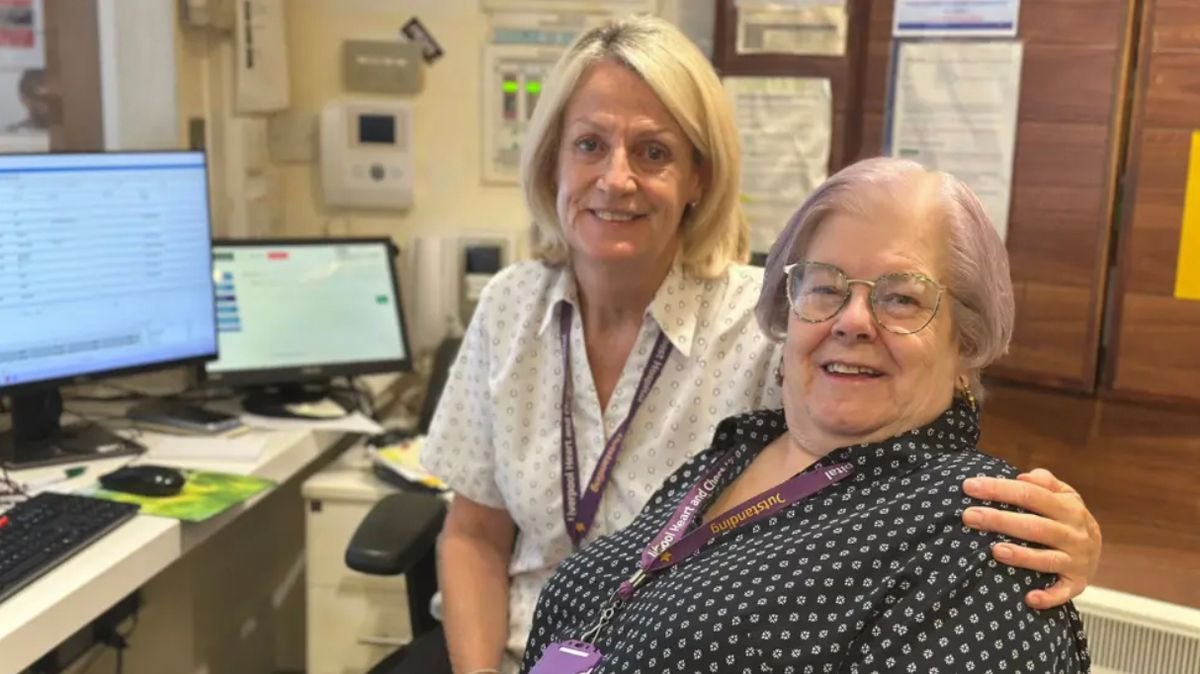
Pat Ward, 70, began feeling unwell in a taxi on her way to Liverpool Heart and Chest Hospital (LHCH), where she works as a switchboard call handler. By the time she arrived for her shift, the pain in her jaw and chest had got worse, and she feared something was seriously wrong.
Pat said: “I arrived on switchboard and told my colleague Debbie that I felt unwell. By now I had jaw and chest pain which had gradually worsened, and it started to feel like my chest was caving in.
Heart hospital worker has heart attack on shift

A switchboard call handler at Liverpool Heart and Chest Hospital (LHCH) has described having a heart attack at work as being like “a bad dream”.
Pat Ward, 70, has worked for the hospital for almost 50 years and was taking a taxi to work when she began to feel unwell last year.
By the time she got to work, her jaw and chest pain had worsened. Pat said: “I felt like my chest was caving in” and told her colleague she thought she was having a heart attack.
Reacting quickly, her colleague raised the alarm to specialists across the hospital.
‘Minutes matter’
Medics assessed Pat and within minutes were performing an emergency treatment to unblock the coronary artery.
Pat recovered from the life-saving procedure and received rehabilitation that encouraged her to make “small changes to become more active, move more and go on walks”.
Dr Jonathan Hasleton, the consultant cardiologist who treated her, said: “Pat came to us at the point where minutes genuinely matter and the reason she did so well is that the people around her recognised what was happening and acted straight away.
The message I would want people to take from Pat’s story is not to wait. If you have chest pain, or pain in the jaw, neck or arms, particularly with breathlessness, nausea or sweating, call 999,” he continued.
“People very often talk themselves out of it and that delay is what does the damage.”
 Pat Ward is now back at work after recovering from a heart attack [Liverpool Heart and Chest Hospital]
Pat is now back at work and has been
reflecting on the care she received. She described the heart attack as “a bad dream”, but added: “Lucky for me, I was at the right place at the right time.”
After 50 years at the hospital, Pat said staff had to restrict visiting on the ward because so many colleagues were checking in on her.
“I was treated like a queen,” she said.
Now, the hospital is encouraging people to be aware of the symptoms of a heart attack and to seek urgent medical help if they experience warning signs such as:
-
Chest pain
-
Discomfort in the jaw, neck or arms
-
Shortness of breath
-
Nausea
-
Sudden sweating
Listen to the best of BBC Radio
More like this story
-
Heart transplant recipient welcomes baby girl
-
Heart failure diagnosis at 29 surreal, doctor says
Related internet links
Liverpool Heart and Chest Hospital
Heart Transplant Recipient, Who Was Days Away from Dying Before Surgery, Welcomes Baby Girl 4 Years Latert
The British Heart Foundation dedicated a special living memorial bench to Dr. Sanjana Kochhar in Otterspool Park in Liverpool, England
NEED TO KNOW
-
Dr. Sanjana Kochhar, a woman in Liverpool, suffered multiple organ failure in October 2022 and survived after she received an emergency heart transplant weeks later
-
In the years since, Kochhar met her donor’s family and was honored with a memorial bench in Liverpool
-
Nearly four years after her transplant, the physician welcomed her first child
A woman who survived an urgent heart transplant has welcomed her first child..
A woman who survived an urgent heart transplant has welcomed her first child.
Dr. Sanjana Kochhar, a general practitioner from Liverpool, England, was near death when she suffered multiple organ failure in October 2022.
Nine years earlier, when she was 20 she would get winded walking up stairs and suffer heart palpitations “every now and again” but chalked it up to a family history of asthma, she told the British Heart Foundation.
The aspiring medical student eventually met with a doctor, who ordered an electrocardiogram and found abnormal results and extensive damage to her heart, including heart failure. She was at risk of going into cardiac arrest and, as a result, was fitted with an implantable cardioverter defibrillator (ICD) that would shock her heart back to a normal rhythm.
While she monitored her deteriorating heart for the next few years, everything changed when one day she was a 29-year-old student and began to feel breathlessness and heart palpitations. “I knew I was dying,” she recalled to the BBC, noting that she was taken in critical condition to a hospital.
“I knew that I was dying and that was hard for me to process and hard to explain to people. I think at the start, when I was probably the sickest, it hadn’t quite clicked that that was what was happening,” she said.
Never miss a story — sign up for PEOPLE’s free daily newsletter to stay up-to-date on the best of what PEOPLE has to offer, from celebrity news to compelling human interest stories.
The young woman had multiple organ failure; she told the British Heart Foundation her kidneys and liver stopped working, and her lungs were full of fluid.
She was in dire need of an emergency heart transplant and was placed on the urgent heart transplant list. Four weeks later—days away from death—she received a donor heart. Kochhar recovered from the emergency procedure and was discharged shortly after on Christmas Eve.
Now, nearly four years later, she welcomed a baby girl, Kochhar shared on World Heart Day, which falls on Sept. 29
Following her health scare, the British Heart Foundation dedicated a special living memorial bench to Kochhar. The bench stands in Kochhar’s city of Liverpool in Otterspool Park. The bench is “a reminder of the journey and the challenges I’ve had along the way,” she told the BBC. It also reminds her of those who are actively “going through difficult challenges, heart-related or anything else.”
She has since visited the bench as a reminder of the “gift” of the transplant and the new life she was given. The physician acknowledged that it was difficult for her to think of the patient who died and who was able to help Kochhar survive.
For me, one of the hardest things to get through was accepting the fact that someone died for me to get a heart. That’s a really difficult thing to process because as a doctor my job is to help people get better,” she told the British Heart Foundation, noting that after counseling with a clinical psychologist she was believed to have post-traumatic stress disorder (PTSD).